The best physiotherapist in Kumaraswamy Layout does more than treat the place where it hurts. Everyday pain and stiffness are common, but they are not inevitable. They are signals that something in how the body is being loaded, moved, or rested needs to change, and understanding that distinction is the starting point for lasting relief.
Most residents manage pain the way most people do: rest for a few days, take something for it, adjust how they sit or sleep, and wait. For short-lived pain from a pulled muscle or a bad night’s sleep, that approach works. The problem is that recurring pain, stiffness that builds through the day, or discomfort that has been quietly present for months will not resolve on its own. It tends to settle in, compound, and eventually affect daily life in ways that feel like ageing but are actually addressable.
In this blog, we’ll look at the most common causes of everyday pain and stiffness, when physiotherapy is the right call, and what good guidance actually involves.
Why Everyday Pain and Stiffness Deserve More Attention Than They Usually Get
There is an important difference between pain that is acute and pain that is persistent. Acute pain, the kind that follows a specific incident like a fall or a sudden strain, is the body’s immediate response to tissue stress. It typically improves with rest and time. Persistent pain is different. It signals an unresolved mechanical issue, a postural pattern, a muscle imbalance, or a habit of movement that has accumulated into something the body can no longer self-correct.
A stiff lower back every morning, a neck that seizes up by mid-afternoon, or a knee that aches on stairs are all presentations that residents in Kumaraswamy Layout tend to normalise. The discomfort becomes background noise, managed daily rather than resolved. Over time, these patterns compound. The muscles that should be supporting a joint stop working efficiently. Adjacent areas compensate and develop their own problems. By the time someone seeks help, what started as a manageable stiffness has often become a more layered condition requiring more time to unravel.
Seeking guidance earlier is almost always more efficient than waiting for a minor issue to become a significant one.
How Does a Physiotherapist in Kumaraswamy Layout Identify the Real Cause?
Through a structured clinical assessment that looks well beyond the site of pain. This is one of the most important things to understand about quality physiotherapy: two people with identical lower back pain may have completely different root causes, and treating them the same way will produce different outcomes for each.
A thorough assessment typically covers posture analysis, movement screening, strength and flexibility testing, and a conversation about daily habits, including how much time is spent sitting, the quality of sleep, activity levels, and occupational demands. A physiotherapist in Kumaraswamy Layout who runs this kind of intake is not being thorough for the sake of it; they are gathering the information they need to design a treatment plan that actually addresses the cause rather than managing the symptom. The assessment itself often reveals things the patient was not aware of, including movement compensations that developed gradually and are now contributing significantly to the pain.
The Most Common Pain Patterns Seen in Residential Neighbourhoods Like Kumaraswamy Layout
Kumaraswamy Layout has a mix of older adults, working professionals, and families, and the pain presentations seen across these groups tend to cluster around a few recurring patterns:
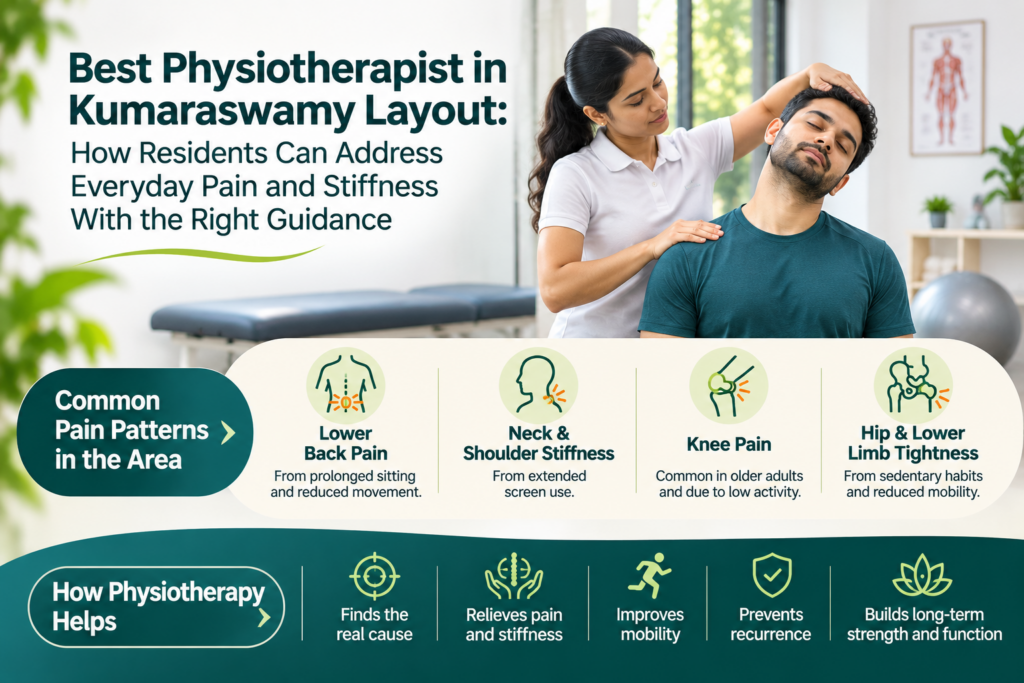
- Lower back pain from prolonged sitting, poor workstation setup, and reduced daily movement. This is the single most common complaint among working-age residents and typically worsens through the week if nothing changes.
- Neck and shoulder stiffness driven by forward head posture from extended screen use, placing sustained load on the cervical spine that accumulates into chronic tightness.
- Knee pain, particularly common in older residents and those with reduced physical activity, where joint changes and weakened surrounding musculature create persistent discomfort on stairs or after long periods of rest.
- Hip and lower limb tightness from sedentary habits, which contributes to lower back and knee issues and is frequently overlooked as a root contributing factor.
What connects these patterns is that none of them are isolated problems. Lower back pain and tight hip flexors are often part of the same picture. Neck stiffness and shoulder restriction frequently share an origin in thoracic mobility and upper back weakness. Treating each site independently, without understanding how the body is functioning as a system, tends to produce incomplete results.
What Good Physiotherapy Actually Involves
A quality session is not passive. The therapist applies hands-on treatment through manual therapy or joint mobilisation, but the session should also include active movement correction and exercises that the patient continues between appointments. Progress depends significantly on what happens outside the clinic, and a physiotherapist who provides only in-session treatment without equipping the patient with independent strategies is delivering only part of the service.
A well-structured treatment plan follows a clear progression: first reducing pain and restoring basic range of motion, then building strength and stability in the affected area, and finally returning to the full movements and habits of daily life without triggering a recurrence. When physiotherapy is integrated with strength training and, where relevant, nutritional and psychological support, results tend to be more durable than manual therapy alone. Pain that has a physical root often also has contributing factors in energy levels, stress load, and body composition, and addressing those alongside the structural work produces a more complete recovery.
What Should I Expect From My First Visit to a Physiotherapy Clinic in Kumaraswamy Layout?
A clinical intake, a physical assessment, and a clear treatment plan — not immediate passive treatment. A physiotherapy clinic in Kumaraswamy Layout that begins hands-on work in the first session without a thorough assessment is skipping the step that makes the treatment meaningful.
To make the most of your first appointment, it helps to come prepared:
- How long the pain has been present and whether it came on suddenly or built up gradually.
- What makes it better or worse, including specific movements, postures, or times of day.
- Any previous injuries or treatments, even those that seem unrelated.
- A rough picture of your daily routine: how long you sit, how much you move, your sleep quality, and your activity levels.
A good first session should end with the patient understanding what is driving their pain, what the treatment plan will involve, and what they will need to do independently between appointments.
When Rest Is Not Enough: Knowing When to Seek Help
The threshold for seeking physiotherapy is not severe or debilitating pain. If a pain has been present for more than two or three weeks without meaningful improvement, if it follows a pattern such as morning stiffness that takes an hour to ease or afternoon neck pain every working day, or if it is starting to limit activities you would normally do without thinking, those are clear signals that rest alone is not resolving the underlying problem.
Earlier intervention is almost always more efficient. A condition addressed at the stage of mild persistent stiffness typically resolves faster and with less treatment than the same condition managed with avoidance for six months. For patients dealing with pain that has both physical and lifestyle dimensions, an integrated approach that considers strength, nutrition, and the psychological weight of chronic discomfort will consistently outperform a narrower, symptom-only treatment plan.
Conclusion
Finding the best physiotherapist in Kumaraswamy Layout is not about locating the nearest clinic. It is about finding a practitioner who takes the time to understand what is actually causing your pain, builds a treatment plan around that cause, and equips you to sustain the results independently. That kind of care addresses the problem rather than managing it indefinitely.
Stiffness and pain that show up reliably every day are not simply a part of getting older or sitting at a desk for a living. They are patterns the body has developed in response to how it is being used, and patterns can be changed. The right guidance does not just reduce pain; it changes how you move, how you feel, and how likely you are to end up back where you started.