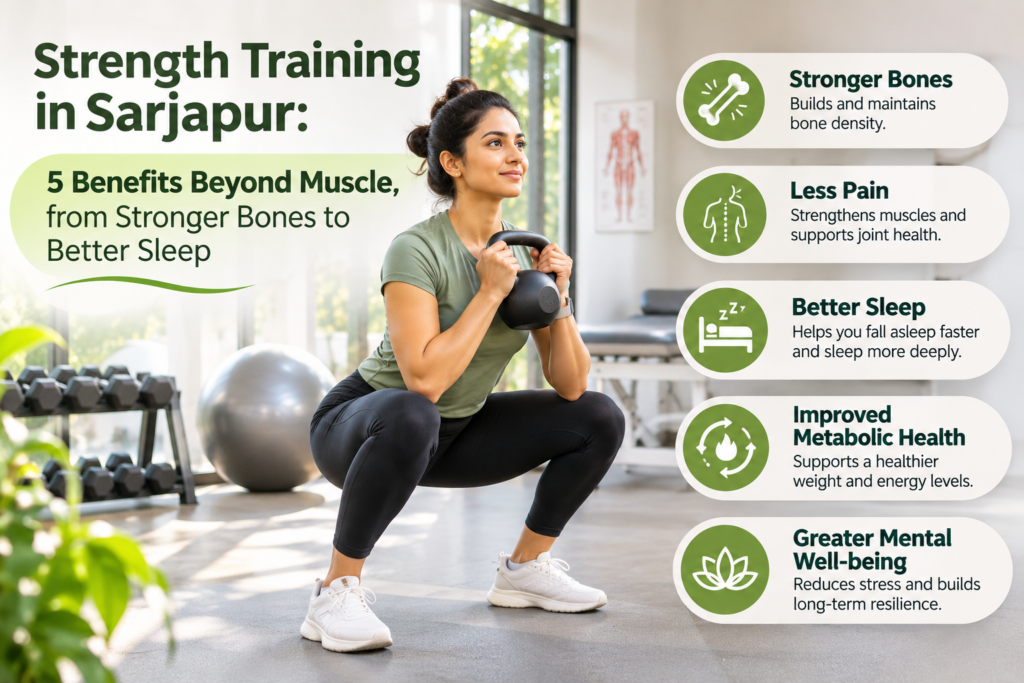
Strength training in Sarjapur is increasingly being recognised not just as a fitness tool, but as a clinical one. Most people associate it with building muscle or losing weight, and while it does both reasonably well, the benefits that actually matter for long-term health run considerably deeper. Bone density, sleep quality, chronic pain, metabolic function, and mental resilience are all areas where resistance training produces measurable, research-backed results.
The irony is that the people who would benefit most from strength training are often the ones most reluctant to try it. If you are dealing with body pain, a recovering injury, or the kind of persistent fatigue that builds up after months of desk work, the instinct is usually to rest, stretch, or do something gentler. That instinct is understandable, but it is not always what the evidence supports.
In this blog, we’ll walk you through five science-backed benefits of strength training that have nothing to do with how you look in the mirror.
Benefit 1: Stronger Bones That Hold Up Over Time
Bone is living tissue. It responds to mechanical load by remodelling and becoming denser, which is exactly what happens when you train with resistance. Studies consistently show that progressive strength training increases bone mineral density, particularly in the spine, hips, and wrists, which are the areas most vulnerable to fracture as we age.
This is not a concern limited to older adults. Sarjapur Road’s working population skews young and sedentary, and low bone density begins developing far earlier than most people expect. Years of sitting, combined with low physical activity, creates conditions where bone loss quietly accelerates well before it becomes clinically visible. Starting resistance training in your thirties or forties is not early preparation for old age; it is addressing a deficit that is likely already underway.
The good news is that bones respond to training relatively quickly. Improvements in bone density can be observed within a few months of consistent, progressive loading, and those gains are durable as long as training continues.
Is Strength Training Safe If You Have an Injury or Chronic Pain?
Yes, provided it is properly supervised and programmed for your specific condition. This is one of the most common misconceptions around resistance training: that it is only for healthy, uninjured people and that loading a painful area will make things worse. The research says otherwise.
Correctly applied resistance training strengthens the muscles, tendons, and ligaments that support injured or painful structures, reducing the mechanical stress on those areas during daily movement. A person with chronic lower back pain, for instance, often benefits significantly from a supervised program that progressively loads the posterior chain, not because the pain disappears immediately, but because stronger surrounding tissue changes how load is distributed across the spine. The key word here is supervised. A physiotherapy-integrated strength program is not the same as following a generic gym routine; it accounts for your movement patterns, your history, and your specific vulnerabilities.
Benefit 2: Less Pain, Not More
One of the more counterintuitive findings in rehabilitation research is that progressive resistance training consistently reduces chronic musculoskeletal pain. This applies to knee pain, lower back pain, shoulder conditions, and a range of other presentations that are extremely common among people living and working on Sarjapur Road.
The mechanism is straightforward. When the muscles around a joint or an injured structure are weak, that structure absorbs more load than it is designed to handle. Strength training programs in Sarjapur that are built around progressive overload gradually transfer that load back to the muscle, which is far better equipped to absorb it. Over time, this reduces the irritation and inflammation that drive most chronic pain presentations.
This does not mean strength training replaces physiotherapy or that any painful condition should be addressed with a heavy barbell. It means that when strength training is part of a supervised, integrated recovery plan, it tends to accelerate results rather than set them back.
Benefit 3: Better Sleep, Backed by Research
Regular resistance training improves sleep onset, duration, and overall sleep quality. This is not anecdotal. Multiple studies have tracked these outcomes across different age groups, and the findings are consistent: people who strength train regularly fall asleep faster, sleep more deeply, and wake less frequently through the night.
The physiological explanation involves cortisol regulation and the body’s circadian signals. Strength training creates a meaningful physical demand that the body recognises as a cue to recover, and recovery requires sleep. It also helps regulate the cortisol cycle, which is frequently disrupted in high-stress, screen-heavy work environments. For anyone working long hours in Sarjapur’s tech corridor and staring at a screen until late, that regulation matters more than most people realise.
Benefit 4: A Metabolism That Works With You
Muscle tissue is metabolically active. It consumes energy at rest, which means that building and maintaining muscle raises your resting metabolic rate. This has practical implications beyond weight management: it affects energy levels throughout the day, blood sugar regulation, and the body’s ability to use nutrients efficiently rather than storing them as fat.
For people recovering from injury or managing chronic pain, metabolic health often takes a back seat to immediate physical concerns. But the two are more connected than they appear. Poor metabolic function contributes to systemic inflammation, which slows tissue repair and amplifies pain sensitivity. Strength training addresses both simultaneously.
Do You Need a Gym to Start Strength Training in Sarjapur?
Not necessarily, but professional guidance matters far more than equipment. A well-designed program can begin with bodyweight and minimal equipment. What makes the difference is whether the programming is appropriate for your body, your current capacity, and any conditions you are managing.
A strength training gym in Sarjapur that operates within a physiotherapy and wellness model is a different environment from a standard commercial gym. The focus is on movement quality, progressive loading that respects your injury history, and outcomes that are tracked and adjusted over time. If you have been dealing with pain or are returning from injury, that context is not optional; it is what makes strength training safe and productive rather than a risk.
Benefit 5: Mental Resilience and Mood Stability
The mental health benefits of resistance training are well-documented and still underappreciated. Regular strength training reduces symptoms of anxiety and depression, improves cognitive function, and builds a particular kind of psychological resilience that comes from doing something hard and watching yourself improve at it.
For people living with chronic pain, there is an additional layer. Pain that persists for months or years affects confidence, self-efficacy, and the belief that the body can get better. Progressive strength training provides measurable evidence that it can. Each small increase in capacity, whether that is a heavier load, a better range of motion, or a pain-free movement that was previously impossible, counters the narrative that decline is inevitable. This is where Ispan’s integration of psychology alongside physical training becomes particularly relevant: the mental and physical dimensions of recovery are not separate tracks, and addressing both produces outcomes that neither alone can replicate.
Conclusion
Strength training in Sarjapur offers far more than the gym-focused framing most people associate with it. Stronger bones, reduced chronic pain, better sleep, a healthier metabolism, and improved mental resilience are all well-supported outcomes of a consistent, properly programmed resistance training practice. For people dealing with body pain, injury recovery, or the cumulative physical toll of a sedentary work life, these benefits are not a bonus; they are the point.
The most important step is starting under the right guidance. Strength training that is integrated with physiotherapy, nutrition support, and psychological care is not a luxury reserved for elite athletes. It is the kind of structured, whole-body approach that produces lasting results for ordinary people with real conditions and busy lives.